.png) 2 day_ago
8
2 day_ago
8

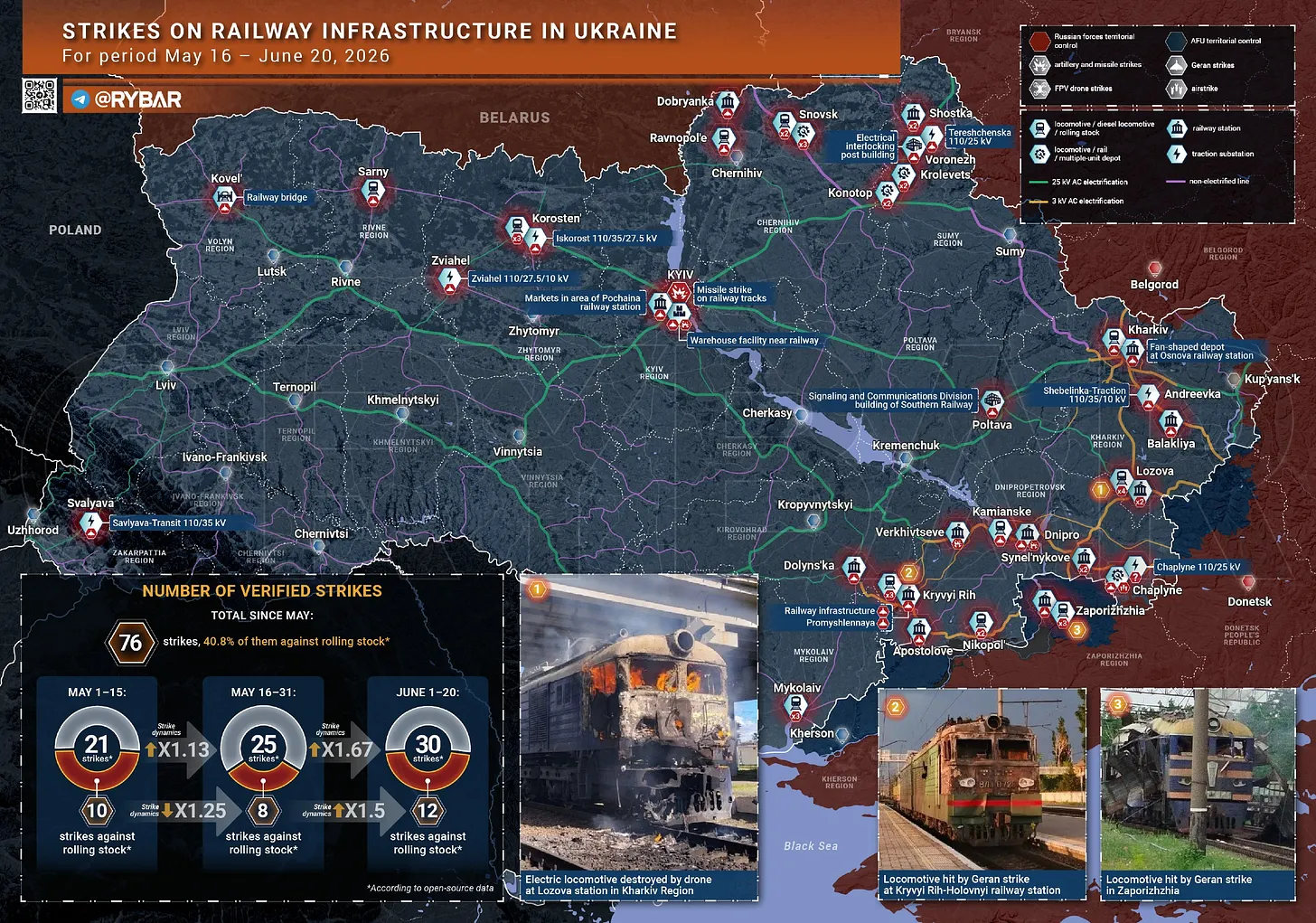
Amidst the latest surge in Ukrainian long-range attacks on Russia, the Kiev Independent outlet released an interesting ‘bombshell’ claiming a “senior Ukrainian official” revealed to them that Trump had privately given Zelensky the greenlight to act “more boldly” against Russia, which we’re meant to presume has been responsible for the latest round of escalations.
To read this article in the following languages, click the Translate Website button below the author’s name.
українська мова, Hebrew, Farsi, Español, Portugues, عربي, Русский, 中文, Français, Deutsch, Italiano, 日本語, 한국어, Türkçe, Српски. And 40 more languages.
.
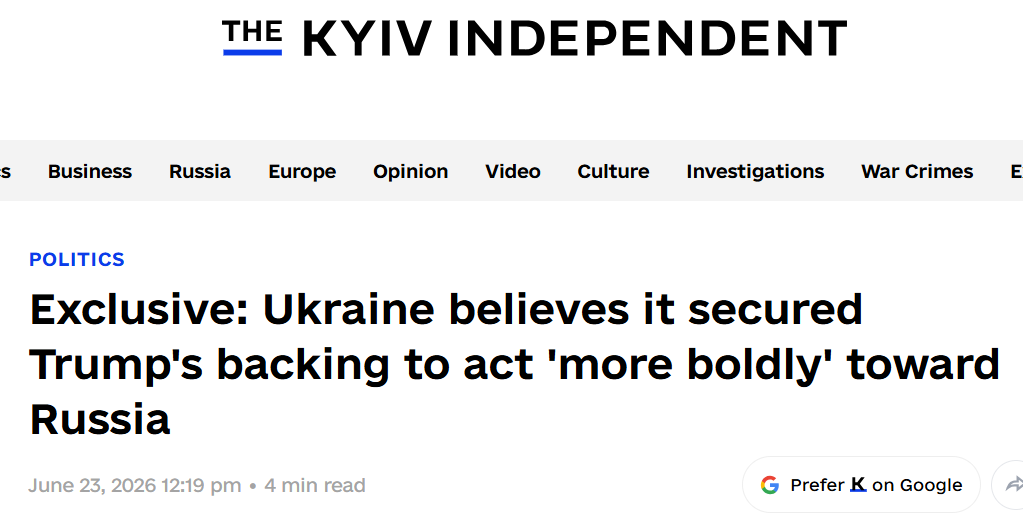
Ukraine now believes it has secured White House backing for a campaign aimed at forcing Russia into meaningful negotiations, the Kyiv Independent has learned.
U.S. President Donald Trump privately told President Volodymyr Zelensky to act “more boldly,” a senior Ukrainian official told the Kyiv Independent.
The message comes as Kyiv intensifies efforts to secure a meeting between Zelensky and Putin — an idea Trump has endorsed but one the Kremlin continues to avoid.
“Trump says he doesn’t really believe (Vladimir) Putin will do anything without pressure,” the official, briefed on the recent Trump-Zelensky meeting, added.
It is interesting for the reason that it is plausible: Trump has clearly been frustrated by his inability to settle any of the conflicts he had promised easily zip up. And recently, on the heels of the Iranian memorandum saga, he even admitted that he would now be “turning his attention” back on Ukraine. As such, it’s believable that Trump would have given secret encouragement for Ukraine to “shape the battlefield” in order to “soften” Russia up ahead of any new attempts by the Trump administration to arm-twist the Russians into concessions.
It’s plausible that Trump believes by exacting heavy “costs” on Russia will create favorable conditions for Putin to negotiate and compromise during whatever next round of attempts that Trump’s stooges (Rubio, Lutnick, Witkoff, etc.) have planned; as the above states, Trump reportedly doesn’t believe Putin will do anything without “pressure”.
But if this is the case, then Trump badly misunderstands the Russian temperament and general change of sentiment that has occurred in the post-Anchorage era, wherein several top Russian officials—from Lavrov to Ushakov—have openly nailed shut the coffin of the so-called ‘Spirit of Anchorage’.
Also, it should be stated that this latest “bombshell” can just as easily be a fake psyop meant to give Ukraine legitimacy in its latest actions—the false impression that the “might” of the US is backing Ukraine’s deep-strike campaign.
One of the key factors that could prove or controvert this claim is whether the latest round of strikes did infact use the US-supplied ERAM missiles as claimed. Ukrainian reports have claimed that Storm Shadows along with ERAM were used to hit an industrial complex in Voronezh. The Extended Range Attack Munition is a new “low cost” US missile that was slated to begin production in late 2026, with some Ukrainian accounts claiming a first batch has already been delivered to Ukraine, though there is no proof as yet; Storm Shadow nose caps were found at the site. There are someunverified Russian reports of ERAM debris having already been found on the front in early June:
The appearance of debris from jam-resistant antennas from the manufacturer of these missiles may indicate that a pilot batch of ERAM ammunition was sent to Ukraine for military testing before the start of full-scale deliveries, scheduled for October 2026.
In the last frames, the appearance of the AGM-188a Rusty Dagger missile during test launches from an F-16 fighter in the USA.
Obviously, if it can be proven that American-made missiles were used to hit a significant strategic asset on proper Russian territory, then it would be the final word on the matter of whether the US via Trump has decided to “raise costs” on Putin.
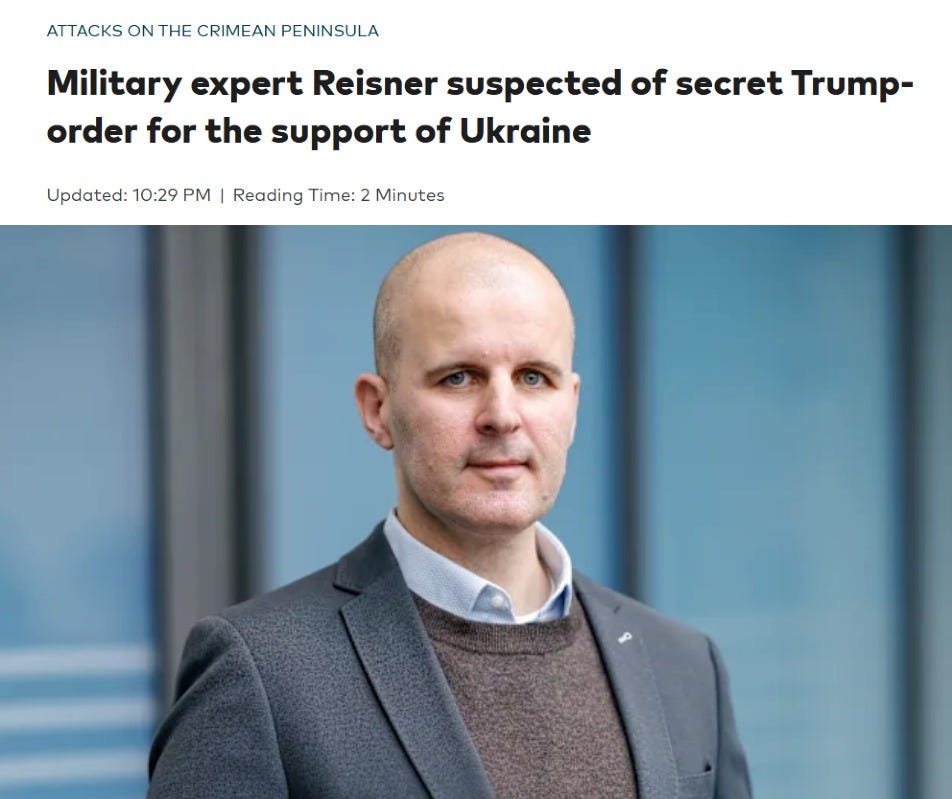
It should be noted, however, that there are some corroborating reports that happened to hit the news mill at the same time. For instance, Die Welt has a new piece from well-known Youtube warfighting ‘authority’ Colonel Marcus Reisner that states Trump likely gave a secret greenlight for US tech bigwigs to escalate their support for the AFU:
.
.
Reisner sees US support behind Ukraine’s newfound military strength: “I am convinced that Ukraine is currently receiving massive support from American Big Tech companies, on various levels,” he told ntv. He cites former Google CEO Eric Schmidt as an investor in Hornet, for example. “But there will also be a mandate from US President Donald Trump to people like Schmidt, Palantir CEO Alex Karp, and others to take on the task of supporting Ukraine.”
He recognizes the “signature of Trump’s so-called tech bros,” Reisner said, referring to past support from Elon Musk through his Starlink satellite network. Palantir’s Maven software also allows Ukraine to locate Russian air defense positions and plan its operations. However, this also creates a dependency for the Ukrainian armed forces.
To be honest, it all sounds quite speculative, particularly given that these mentioned figures and companies have already been working hand-in-glove with Ukraine since the start of the war, or even beforehand.
But FT also chimed in—in what seems more and more like a coordinated info front—stating that Trump had recently expressed great “enthusiasm” to Zelensky about Ukraine’s successes, which would seem to comport with the above reports.
Instead, Trump was “hugely impressed and enthusiastic” about Ukraine’s recent campaign of long-range strikes on targets deep inside Russia at last week’s G7 summit, said two people briefed on the private discussions among the leaders. Trump at that summit also agreed to increase sanctions on Russian energy.
Let us be honest: when analyzed critically, we can conclude that much of the recent escalations are owed entirely to the vast uptick in advanced, longer-range, un-jammable (via Starlink) drones supplied to Ukraine primarily from Europe, but also the US (Hornet, etc.).
.

.
According to reports, Germany has delivered 6,000 new medium-range drones to Ukraine, with which Russian military logistics are to be disrupted and the supply of the front via Crimea and the liberated areas is to be prevented.
The federal government is supplying thousands of kamikaze drones developed by the AI company Heling (Munich). These one-way drones are not manually controlled, but operate in a target-autonomous manner.
Germany is de facto a participant in the war. No more sugarcoating can help with that.
These have been ravaging the Crimean corridor with concomitant effects on more distant Russian regions likely due to the combined issues of Russia having to pull and redeploy air defenses, potential AD missile shortages, and AD system attrition on the leading edge of the Crimean frontline. That is to say, recent events could be explained by that alone, rather than absolutely requiring some mysterious escalation from Trump himself.
Here Putin lays out the stance that European countries which are pursuing such escalatory policies against Russia are paying for it with political crises, as we just witnessed with the resignation of Starmer:
.

.
This seems to be a clue as to Putin’s stance apropos the ongoing events, and it is one that reflects what we’ve been writing here: Russia needs only to continue plying its grinding war and await the slow political collapse of Europe.
Which brings us to the next point: Many will argue that this is an untenable position for Russia because Ukraine’s recent strikes are doing increased and “unsustainable damage” to Russia. The reality is that Russia has both symmetrical and asymmetrical answers for Ukraine’s recent surge. This is how Russia will likely negate these new attacks, as it has done in prior years when Ukraine had similar brief spurts of “mass strikes” on Crimea with various wunderwaffen of the time, like ATACMS, HIMARS, etc.
What is the method?
You see, there remain many spoken and unspoken “agreements” on the battlefield, some of which have to do with hitting certain civilian infrastructure, political leadership HQs, energy pipelines—particularly those that go to Europe. One of these “secret handshake” agreements has to do with the Odessa port and Ukraine’s international shipping, which Russia for a long time had allowed to go unmolested. The same obviously goes for a lot of civilian infrastructure which soft-hearted Putin had not the appetite to strike.
Now, in light of Ukraine’s latest campaign, it seems Russia has begun taking the gloves off on some of these, and depending how far it goes, Ukraine could be forced to curb its attacks to stave off its own economic collapse. There are various reports of Russia now hitting smaller local electrical infrastructure, gas stations, postal depots, ships en route to Odessa, etc.
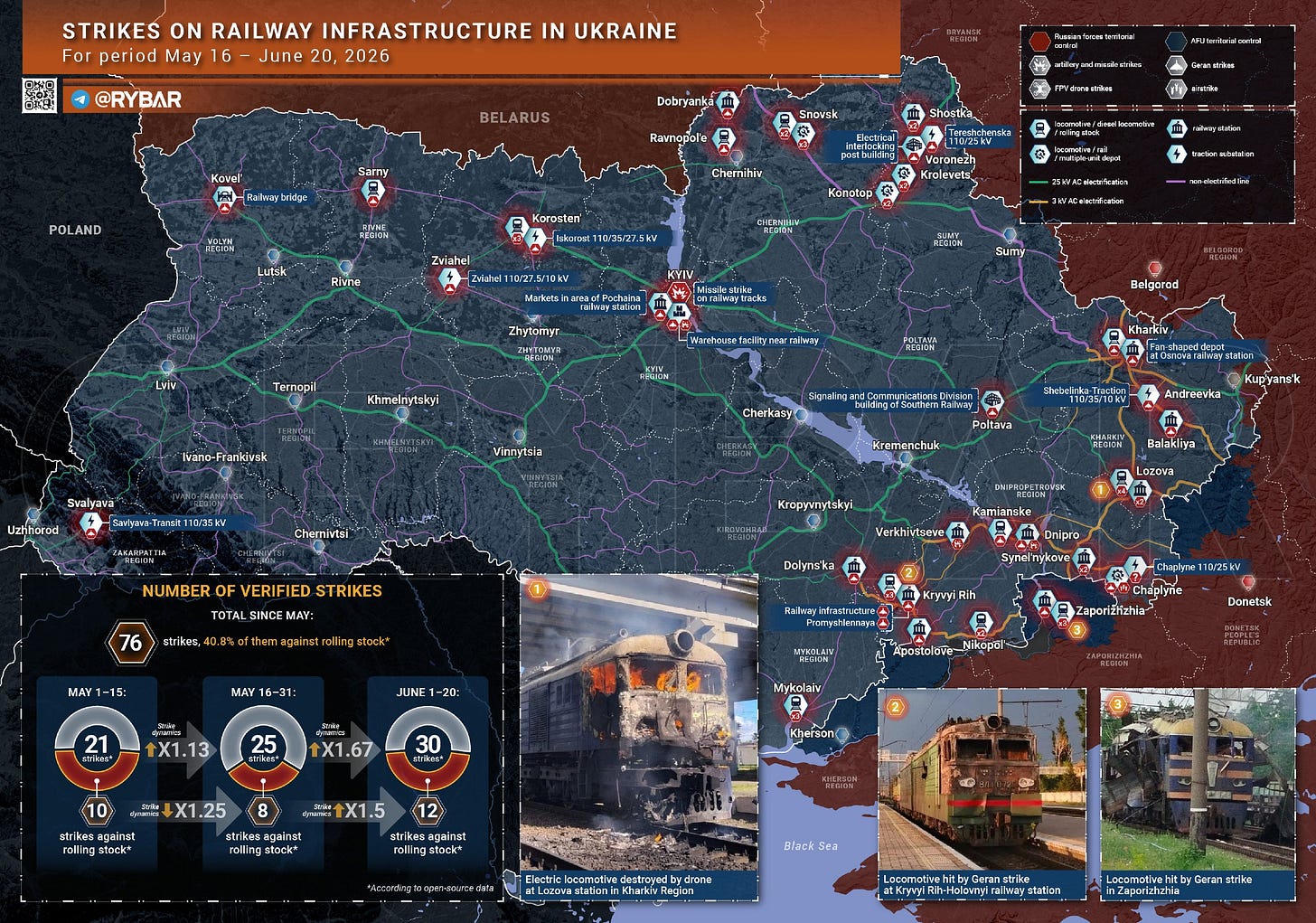
One of the big ones has been a new Russian campaign against Ukrainian railways, which we’ve written about recently. Rybar published a report on it today with many linked geolocations:
.
Click here for an enlarged view
.
📝Train Hunting📝
The task of freeing so-called Ukraine from railway logistics has gradually grown in priority as the special military operation has progressed. With the evolution of the situation on the front and the development of strike capabilities, tactics and approaches have changed.
Initially, strikes targeted mainly infrastructure. However, any static railway facilities, while vulnerable, either recover quickly if necessary or alternatives emerge to bypass their absence or shortage.
Therefore, if one approaches the destruction of infrastructure systematically—one must destroy not just “real estate.” This is why the intensity of strikes against rolling stock is also increasing. Locomotives and other types of trains in so-called Ukraine remain a scarce commodity, and their production or restoration requires enormous expenditures.
🔻Examples of successful strikes
▪️In Mykolaiv, a diesel locomotive was struck by a Geran strike.
▪️In Zaporizhia, a locomotive was destroyed using Geran-2.
▪️In the area of Ravnopillia, Chernihiv Region, a shunting diesel locomotive was damaged by Geran-2.
▪️In total, from May 16 to June 20, 21 confirmed strikes against rolling stock were delivered.
Even accounting for the AFU’s tendency to understate damage, statements from the enemy’s relevant agencies about problems indirectly confirm the successes of the Russian Armed Forces.
➡️According to statistics, the greatest number of strikes against trains currently falls predominantly on front-line regions of so-called Ukraine, as well as those bordering Belarus. It is not unlikely that this partly became the reason for Zelenskyy’s recent provocative statements toward Lukashenko.
A telling example here is Zhytomyr Region. In just the first week of September, more than 20 locomotives were destroyed in Korosten and on adjacent railway routes.
❗️For a region that serves as a key transport hub connecting western regions of Ukraine with the center and east, the destruction of locomotives reduces railway capacity and increases delays in the delivery of fuel supplies and humanitarian cargo, while also contributing to increased pressure on alternative road routes.
📌And although, purely due to geography, creating an analogue of the “Crimean blockade” for so-called Ukraine is hardly possible—disrupting cargo transportation is very much achievable. And beyond the obvious economic costs, this will also complicate military logistics.
In the meantime, as part of its largely artificial info-campaign, Ukraine had published one or two strikes against some Russian railway to great jubilation on the pro-UA side, as if this was a “crippling blow” to Russia—all the while ignoring a Russian campaign that has seen dozens of Ukrainian locomotives and railway infrastructure nodes taken out just in the past few weeks alone.
Similarly, Russia has begun “free-hunting” Ukrainian tankers all over the country, burning arguably as many of them as Ukraine has burned of Russian ones in the Crimean corridor—again to silent chirps from the pro-UA crowd.
Click here to read the full article on Simplicius.
*
Click the share button below to email/forward this article. Follow us on Instagram and X and subscribe to our Telegram Channel. Feel free to repost Global Research articles with proper attribution.
Featured image source
Global Research is a reader-funded media. We do not accept any funding from corporations or governments. Help us stay afloat. Click the image below to make a one-time or recurring donation.



















.jpg)


 French (CA)