

.png) 2 hour_ago
28
NE LAISSER PAS LE 5G DETRUIRE VOTRE ADN Protéger toute votre famille avec les appareils Quantiques Orgo-Life® Publicité par Adpathway

Open the Turkish Wikipedia entry on the Peloponnesian War and the cause is waiting for you in the first paragraph. The war broke out, it says, because a “wealthy and rising Athens” came to be seen as a threat by the other city-states, Sparta above all. Then the lines are drawn. On one side stands Athens, governed by democracy; on the other, a “more oligarchic” Sparta. The cities of western Anatolia back Athens. And behind Sparta looms a foreign empire: Persia, bankrolling the Spartan fleet in return for a claim on Ionia.
Whoever reads that paragraph is not reading the fifth century BC. They are reading this morning’s news. A prospering democracy, an envious oligarchy, loyal friends rallying to the democracy, and an Eastern empire pouring gold into the oligarch’s coffers. It is the world map of the “Summit for Democracy” convened in Washington in 2021: democracies on one side, autocracies on the other, and somewhere in the back a foreign power ferrying money and weapons. History is being rewritten to suit the present, and the rewritten history projects the present’s battle lines back onto antiquity.
Every sentence in that tableau is hollow underneath. The cities of western Anatolia did not “back” Athens; they paid it tribute. Athenian democracy was a democracy of adult male citizens, resting on slave labour and on the tribute wrung from its allies. Nor was Sparta the only one with its hand out for Persian gold; towards the end of the war Athens came knocking at the same satraps’ doors. What has been erased above all is the war’s class face. Inside the cities Thucydides describes, the common people called in Athens and the wealthy called in Sparta. The war between two states was also a war between classes, fought out in every city.
This narrative has a twin. Graham Allison distilled from the same war a model he called the “Thucydides Trap”, and within a decade it was being repeated everywhere. In this model Athens is the rising power, and China is seated in its chair; Sparta is the established power, which is to say the United States. Wikipedia’s democratic Athens, by contrast, is the West itself. The same war is staged in two Western narratives with the roles reversed. In Turkish commentary the casting gets shuffled yet again: one newspaper likens Athens to the United States and Sparta to China, while a columnist quotes Thucydides backwards, so that Sparta rises and Athens trembles. The casting changes with the author. One thing never changes: in every version, the West is in the right. If it is rising, that is legitimate growth; if it is established, that is legitimate fear; if it is a democracy, it is virtue itself.
In this play there is only one actor whose part never changes, and he stands at the edge of the stage: Persia. Athens is sometimes China and sometimes America; Sparta is sometimes Washington and sometimes Beijing. Persia stays the same in every cast list: the despotic foreign power in the East, pouring out gold and feeding oligarchy. The part is not new. The West first defined itself against Persia. “Free Greeks” against “Oriental despotism” is a costume that has been fitted onto every new enemy for two and a half thousand years. The Spartans who died at Thermopylae became, on the Hollywood screen, the three hundred of 300, a legend that turned the Persian army into a horde of monsters. In the same legend Sparta is freedom’s sentinel while it fights Persia, and an oligarchy the moment it takes Persian money. The yardstick is not Sparta itself but its relation to the East. And the pattern’s present address is plain to see: Iran, cast in the role of Persia, is also the rightful bearer of the name.
The line about Persia “laying claim to Ionia” comes out of the same mould. Before the Persian Wars, Ionia was Persian territory. The “liberated” Ionian cities began paying tribute to Athens the morning after their liberation. Persia’s “claim” amounted to asking for the return of a region Athens had seized. Seventeen years after the war ended, the King’s Peace of 387 handed Ionia back to Persia, and those who signed it were the Greek cities themselves.
A model that does not know who its own heroes are is not a model but a garment, cut to fit whoever happens to wear it. To see who tailors that garment, and why it is in such demand, we first have to go to Seattle, on an evening in September 2015.

Seattle, 22 September 2015. Xi Jinping, President of China, is speaking at a dinner for business leaders and officials before travelling on to Washington. At one point he answers a concept that the American press had pushed onto the agenda without asking anyone: there is no such thing in the world as a “Thucydides Trap”, he says; but should major countries make strategic miscalculations again and again, they may build such traps for themselves.
A head of state found himself obliged to refute an analogy floated in a newspaper column three years earlier. That alone tells you how fast the concept had travelled. Yet the second half of the sentence says more. Even the man rejecting the trap was speaking the trap’s language. The analogy itself had slipped beyond dispute; all that remained to argue about was whether it could be escaped.
Since that evening, “the Thucydides Trap” has become the most recited formula in geopolitics. It circulates from the think tanks of Washington to official speeches in Beijing to the talking heads of Turkish television. But once a concept spreads this far, everyone who uses it has quietly accepted the assumptions it carries. This essay puts those assumptions on the table: the concept’s method, what the classic it leans on actually says, and why it has proved so useful.

The concept belongs to Allison, the dean who built Harvard’s Kennedy School into its present shape: he headed it from 1977 to 1989, and later served in the Pentagon under Clinton. He launched the idea in a 2012 article in the Financial Times and turned it into a book in 2017, Destined for War. The thesis is short. When a rising power threatens to displace an established one, a structural drift towards war sets in. As evidence he offers sixteen cases from the past five hundred years, twelve of which, he says, ended in war.
At first glance the list impresses. At second glance you see what has been thrown into the same basket. The sixteenth-century rivalry between the Habsburgs and France sits in the same category as the Anglo-German clash of 1914. No distinction is drawn between the dynastic squabbles of absolute monarchs over succession and land, and monopoly capitalism’s war to redivide the world. Behind the cases there is no mode of production, no class, no accumulation of capital; only two powers and the distance between them. Lenin’s account of 1914 as a war among imperialists for the repartition of the globe simply vanishes from the table. War becomes a balance-of-power accident that recurs in every age.
Nor is the classification itself innocent. The rivalry between the United States and the Soviet Union is counted among the cases that “ended without war”. The blood spilled in Korea, Vietnam, Afghanistan, Angola and Central America does not enter the reckoning, because the two great powers never fired on each other directly. So long as the centres do not go to war, the dead of the periphery never make it into the statistics. This is not a historical table; it is a map of the world as seen from the centre. As theory, the compilation is foolish. But its foolishness does not point in a random direction.

The sentence on which Allison builds his entire edifice comes from the first book of the History of the Peloponnesian War. Having listed the grievances openly given for the war, Thucydides names the real one: the growth of Athenian power and the fear it inspired in Sparta. He calls it the “truest cause, though the least spoken of”. Allison wields that sentence as the seal of a classic twenty-four centuries old.
Yet the sentence says something a surface reading cannot see. Fear is not a cause; it is the reflection of a cause in the minds of those who feel it. It is a psychological category. To say “Sparta was afraid” explains nothing until you say why Sparta was afraid, and what it feared to lose. And this is where Thucydides shows his greatness: he leaves the answer in the pages of his own work. Those who claim to be his heirs do not trouble to turn them.
Allison takes a single sentence and leaves the remaining seven books on the shelf. To read a classic through one underlined line is to turn it into a vehicle for borrowed grandeur. One swallow does not make a summer, and one sentence does not make a philosophy of history.
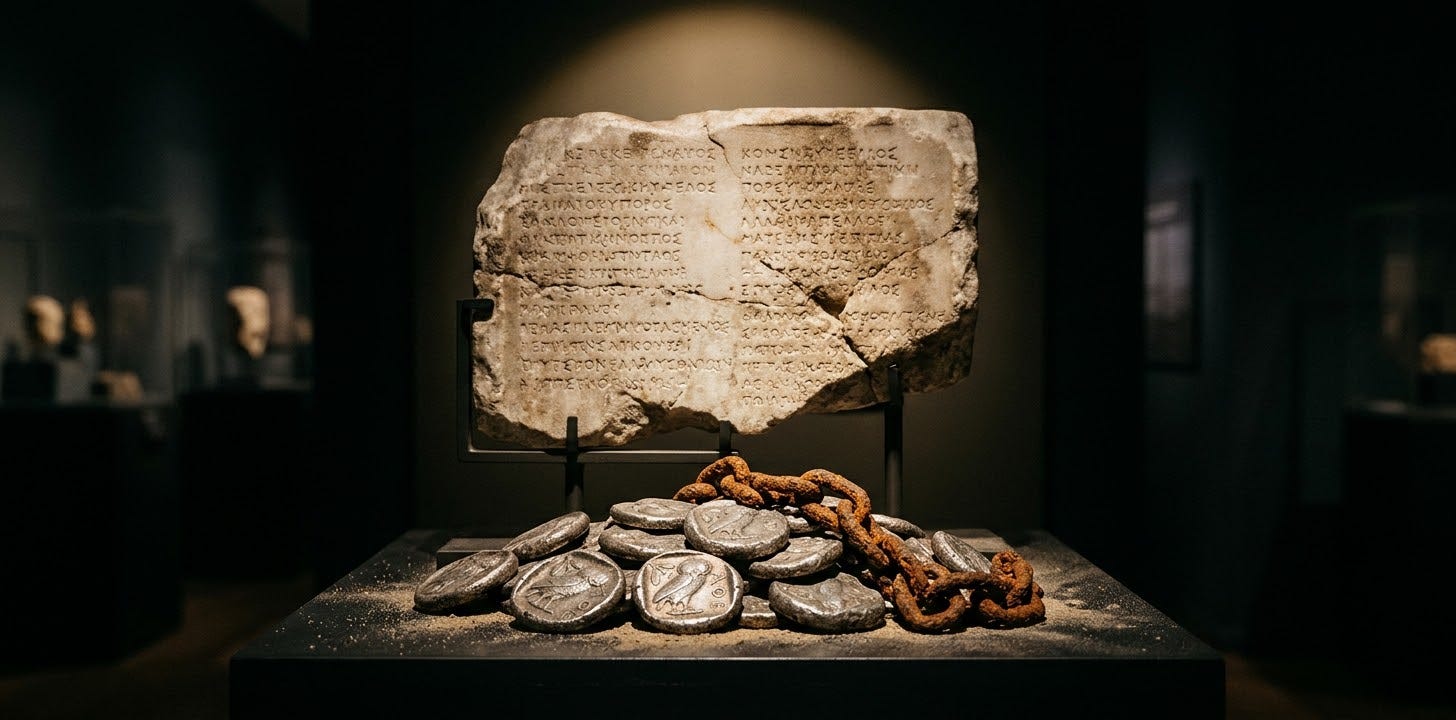
The two cities Thucydides describes were not two abstract powers squaring off. They were two distinct social formations.
What is called the “growth” of Athens did not fall from the sky. The Delian League, founded after the Persian Wars, began as an alliance for common defence. Over time Athens moved the league’s common treasury from Delos to its own city. The allies’ contributions hardened into tribute. Cities that tried to leave the league were brought to heel by the fleet. Part of the splendour of the Acropolis was paid for out of that tribute. This was the growth of a maritime empire that levied tribute on its partners and held them by force.
Nor was Sparta’s “fear” abstract. Sparta was an aristocracy that lived by keeping a slave population many times its own size, the helots, bound to the soil. Thucydides himself writes that most Spartan institutions were designed with security against the helots in mind. Sparta’s famous caution, its reluctance to keep its army abroad for long, sprang from the dread that the vacuum left at home might turn into a revolt. The more Athenian power grew, the greater the chance that this balance would break.
So even Thucydides’ own text shows foreign policy arising from the ruling class’s order of exploitation at home. What drove Athens outward was an economy of tribute; what drove Sparta inward, and finally into war, was the fragility of a slave order. The fashionable reading wipes out this layer and leaves behind nothing but two powers afraid of each other. Take away class and you are left with psychology; and once you are left with psychology, war starts to look like fate.
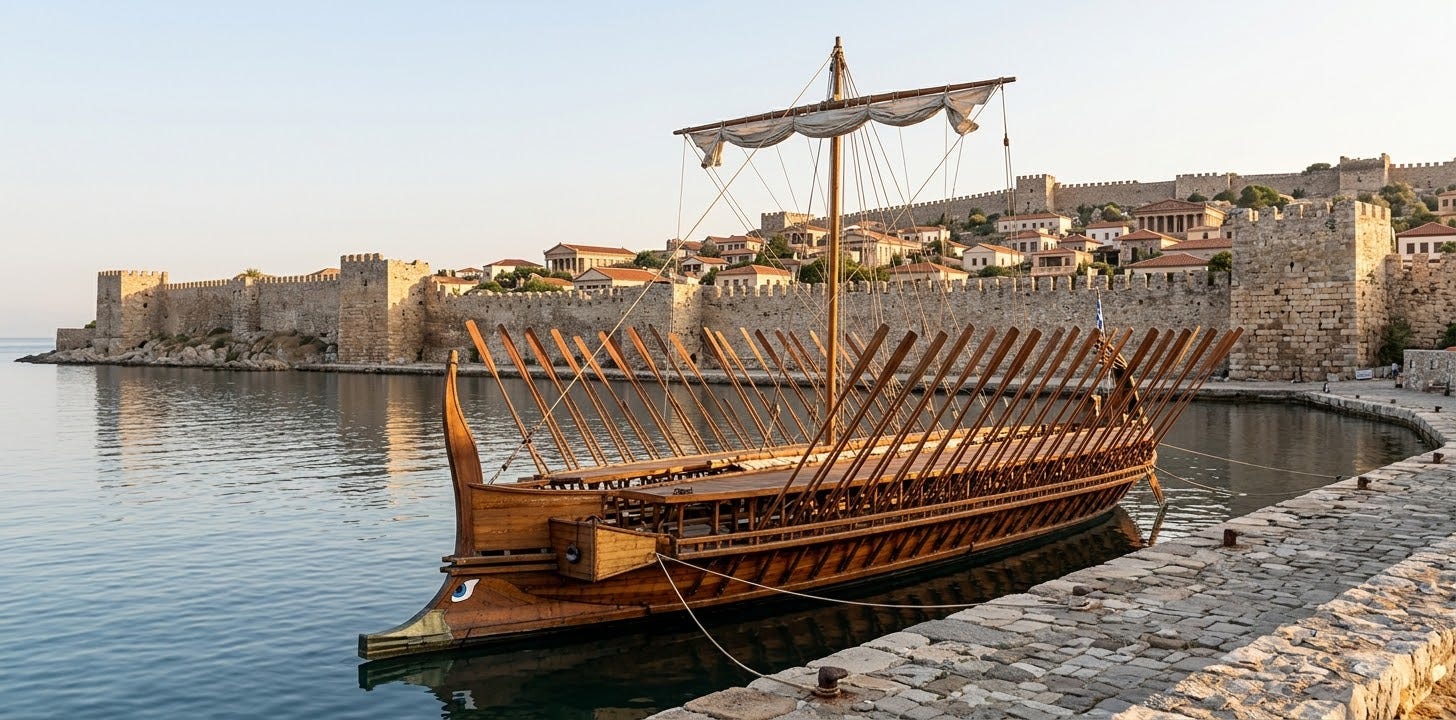
Set the model against history itself and the cracks show at once. The first is in the calendar. Athens’s real ascent came straight after the Persian Wars, roughly between 478 and 450 BC. The Delian League was founded in those years; the common treasury moved to Athens in 454. The Peloponnesian War began in 431. Half a century separates the rise from the war. Thucydides narrates those fifty years separately; to miss the gap, you have to not read the classic.
The second crack lies in what happened during that half-century. The two cities had already fought each other, between 460 and 445. That first war ended with the Thirty Years’ Peace of 446–445, in which each side recognised the other’s sphere of influence. By 431 Athens was not a rising power but a maritime power fifty years established. Pericles’ war strategy was not attack but defence: abandon the countryside, withdraw behind the walls, hold out by sea.
The third crack lies in what set the war off. The spark was not the rise itself but the clash between Corcyra and Corinth in 433, the siege of Potidaea in 432, and the decree that shut Megara out of Athenian harbours. What dragged Sparta into war was the pressure of Corinth, an ally whose sea trade was being hurt. The Spartan king Archidamus opposed the war; the assembly voted for it anyway. There is no “trap” here, only a concrete chain of commercial interests among allies and of internal balances.
The fourth crack is the outcome. The war was won not by “rising” Athens but by “established” Sparta, and with a fleet built on Persian gold at that. The model’s showcase case follows none of the steps the model predicts.
The same holds for Allison’s nearest case. Were the model true, the United States and the Soviet Union would have gone to war directly during the Berlin blockade of 1948, the Berlin crisis of 1961 and the Cuban crisis of 1962. They did not. Allison rescues himself by filing the case among the “exceptions”. A model that turns its own most important example into an exception has stopped being a model; it has become ornament for a claim.
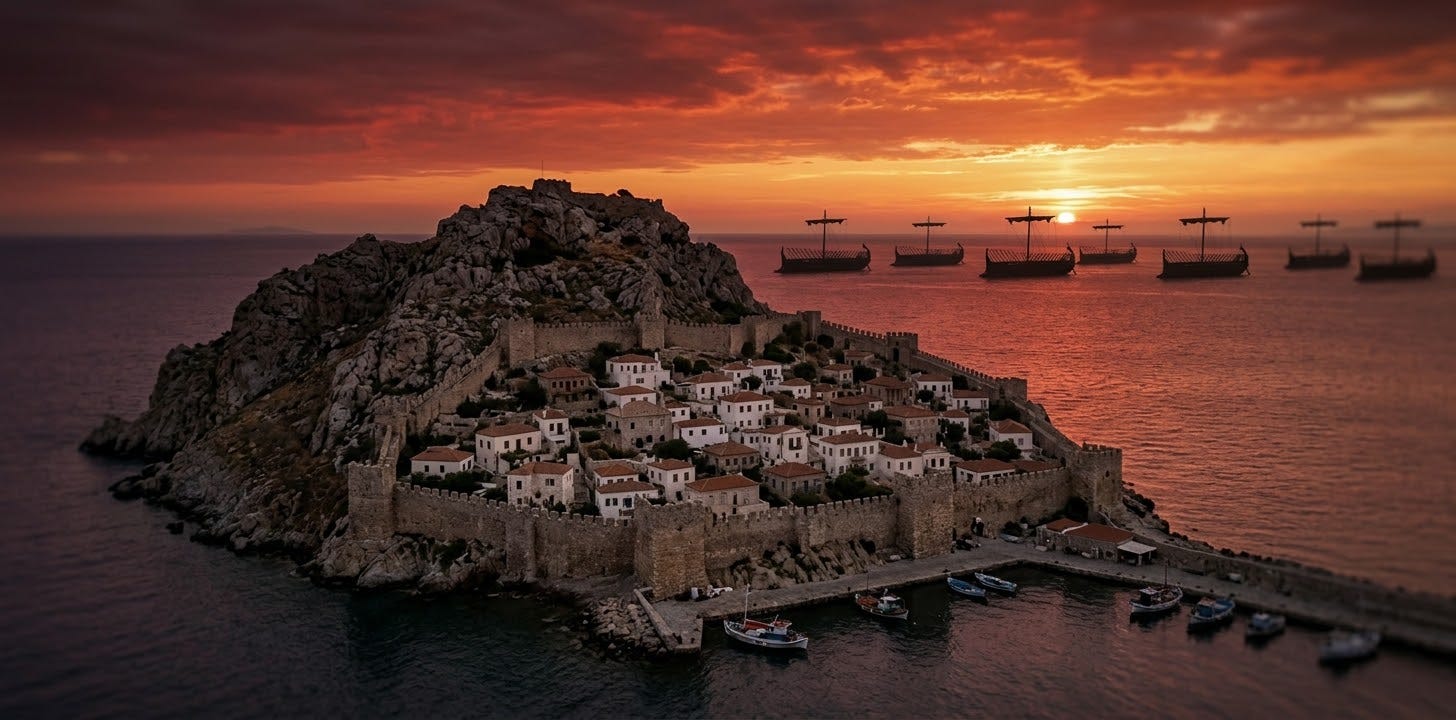
The second passage the realist tradition most loves to quote from Thucydides gives away whose voice this reading has adopted. In 416 BC Athens sends a fleet to Melos, a small Aegean island that wants to stay neutral in the war. The Athenian envoys tell the islanders that talk of justice is pointless: the strong do what they can, and the weak suffer what they must. The Melians refuse to surrender. The island is besieged and falls; the men of fighting age are put to death, the women and children sold into slavery.
Realism hands that sentence down as the eternal law of international relations and places it at the front of its textbooks. But it is not a law. It is an imperialist power’s justification on the eve of a massacre. Thucydides stages the dialogue like an exhibit, and it is no accident that he moves straight on to the Athenian catastrophe in Sicily. Realism, for its part, embraced the exhibit. It took words from the mouth of one of history’s first imperialists, framed them as theory and hung them on the wall.
Allison’s trap and the Melian Dialogue are two sides of the same coin. One presents war as fate, the other presents bullying as a law of nature. In both, the classes behind the states, the interest of the aggressor and those who pay the price of the aggression all vanish from view.

The concept’s vogue is no accident. There is no need to know what Allison intended; it is enough to look at what the concept does. Its function has three layers.
First, it tears war away from the interests of monopolies and ruling classes and turns it into a fate born of the relative position of two powers. Fate has no one to answer for it. Who wants the war, who will profit from it, who will pay for it: these questions are cleared off the table.
Second, it lays the blame on the rising side. If the trap springs from the rise, then the one who sets the trap is the one who rises. The declining centre’s bases, sanctions, fleets and tariff walls come to look like defensive precautions against an unavoidable danger. The aggressor is shown on the defensive, the defender on the attack.
Third, the analogy carries a verdict of its own. As we saw at the outset, the roles shift from author to author. But every use that seats China in Athens’s chair casts it not merely as a “rising power” but as an imperialist sea power that levies tribute on its allies and lays siege to Melos. The thesis of inter-imperialist rivalry is thus reproduced in the guise of a historical analogy, with no evidence required. No one needs to ask about the mode of production, the nature of capital exports, or who owns the bases and the fleets. The analogy has been drawn; the verdict is in.
That the concept has been taken up even in circles that stand against the United States shows how deeply the realist frame has been driven in. The answer in Seattle was the first example. Even those who reject Washington’s thesis speak in Washington’s vocabulary, rejecting the trap in a language that grants the trap exists.
Turkey supplies its own example. A newspaper column that claims to defend China describes the latest summit between Trump and Xi as a meeting held on the very threshold of the trap. It quotes Thucydides backwards, insists the trap is not inevitable, yet adopts the frame of hegemonic power and rising power wholesale. It declares China anti-hegemonic and at the same time makes it the subject of a “transition”, though a transition can only be a transition from one hegemon to the next. And it looks for what will prevent war not in classes but in the culture of games: the West plays chess, China plays go. Allison tied war to fear; this column ties peace to a board game. In neither is there a mode of production, capital or class. To build the West’s dichotomy of “civilisation and barbarism” in reverse is not to escape the dichotomy.
How did so shallow a concept lodge itself, within ten years, in every mouth from Washington to Beijing? The answer lies not inside the concept but in the structure standing behind it: Harvard, the think tanks, Foreign Affairs, the Financial Times, the television screens and the army of commentators who watch them. What spread the concept was not its depth but the apparatus behind it. Had someone without a name or a chair written the same analogy, it would have yellowed quietly on a magazine page.
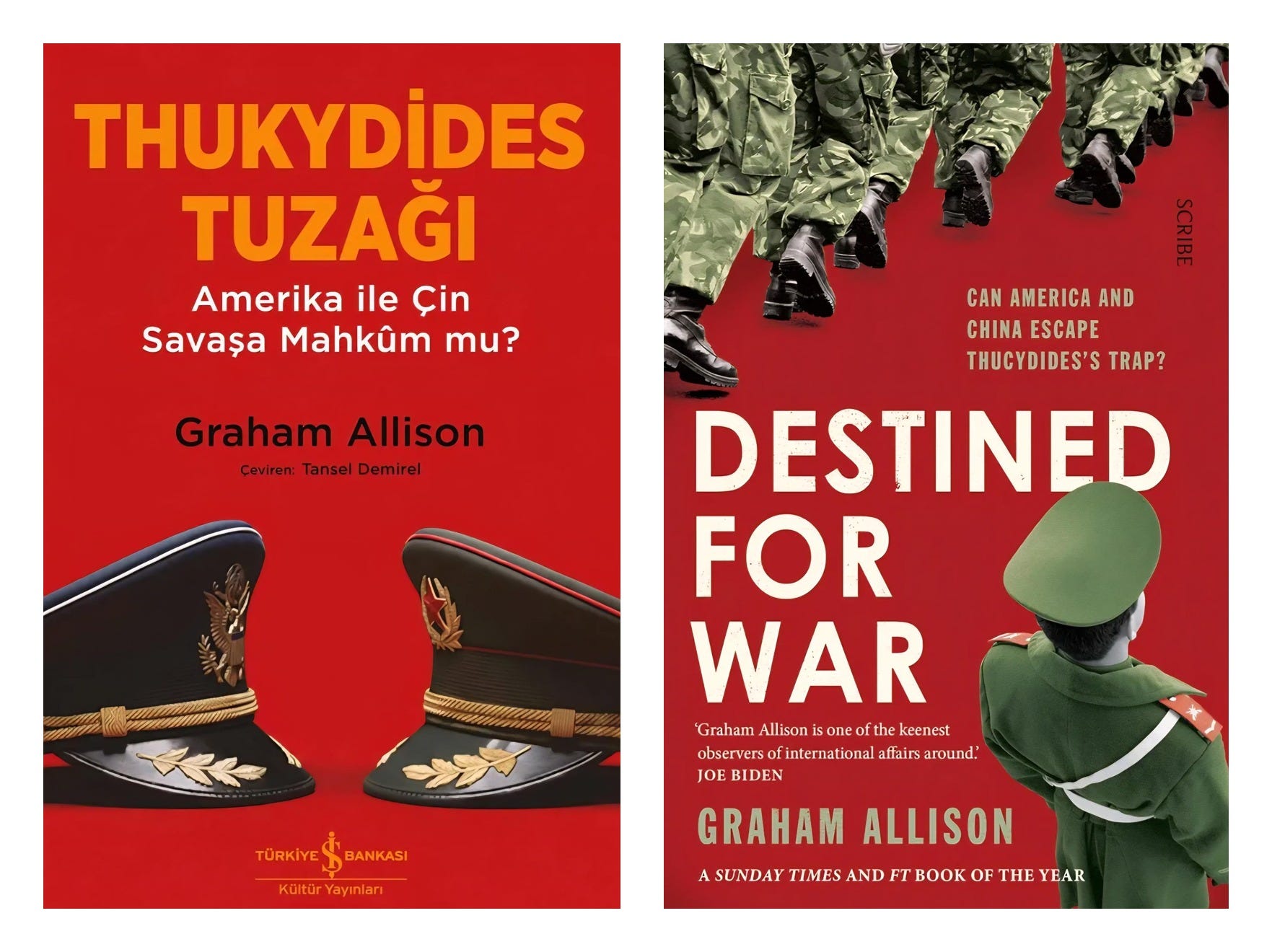
The apparatus gives itself away even on the book’s cover. The British edition of Destined for War carries a tribute from Joe Biden: Allison, in his view, is one of the keenest observers of international affairs. Below it, the cover announces that the Sunday Times and the Financial Times named it a book of the year. The newspaper that launched the concept in 2012 crowns the book five years later. Renown turns in a closed circle: the newspaper spreads the concept, the book leans on the newspaper, the newspaper rewards the book, the politician praises the book, and the politician’s praise sells it. Nowhere in that circle does anyone ask whether the book is true.
Sociology even has a name for this. The American sociologist Robert Merton called it the “Matthew effect”, after the verse in the Gospel: “For unto every one that hath shall be given.” The ordinary idea of a famous person is read more, cited more and repeated more than the original idea of an unknown one. Fame feeds on itself, and that is precisely what severs the link between an idea’s truth and its spread. Renown is not truth.
Some of the texts taught at the most famous schools leave a careful reader with the feeling of being mocked. That a text is taught there tells you not about its quality but about what those institutions need. The Thucydides Trap is such a text: foolish as theory, serviceable as ideology. It presents war as fate, lays the blame on the rising side, and does so with the authority of a classic twenty-four centuries old. That so foolish an idea could spread so far is the measure of the power of the institutions that spread it.

There is no law called the Thucydides Trap. But there is a trap: a trap for thought, one that blocks the road to asking what causes war. Whoever falls into it looks for the cause of war in the distance between two powers, and does not find it. For the cause of war lies not in that distance but in the interests of the classes behind the states.
The picture history shows us is the reverse of Allison’s. A centre that is losing its economic primacy turns to make up the loss with the last advantage left in its hands: military force. When the most advanced falls behind, it reaches for the sword. Today the power with bases in every corner of the globe, the power that started most of the wars of the past thirty years, the power that has turned sanctions into an everyday instrument of policy, is not the rising power but the declining one. The danger of war comes not from rising but from the attempt to halt decline by force of arms.
That is why the second half of the answer in Seattle was right, but incomplete. There really are those who build traps with their own hands. Only the trap they build is not war itself but the vocabulary that makes war look like fate. There is no way out of the trap without giving up that vocabulary. 【●】



















.jpg)


 French (CA)