

.png) 5 month_ago
59
5 month_ago
59

The fundamental aim of the article is to present an alternative view and facts on the background of the military-political case of the „Vukovar operation“ in 1991 in the broader context of the internal and external brutal destruction of the Socialist Federal Republic of Yugoslavia (SFRY), historical disputes and struggles between the Serbs and the Croats as well as in the context of the international law and moral guidelines of the global politics and regional security at the time of the very beginning of the post-Cold War era of the international relations. The article is breaking a traditional post-Cold War Western historiographic and political standpoints on the nature of the destruction of ex-Yugoslavia, followed by the bloody wars for its succession, and as such can be an important contribution to making a more objective scientific picture on the topic of the disappearance of the SFRY in the 1990s.
The Nature of the “Vukovar Operation” in 1991
The almost three-month battle for this Western Srem city on the Vuka and Danube rivers (from August 25th to November 18th, 1991) will still provoke reactions from both “their” and “our” historians, but enough water has flowed down both the Vuka and the Danube so far to make a somewhat relevant judgment about this Croatian-Serbian ethno-political epic from a sufficiently distant and neutral historical distance, but taking into account the personal experiences of the author of the text as a witness to the time of the breakup of the SFRY in which he lived at the time.[1]
Croats and post-Yugoslav Croatian “Tuđmanology” consider the 1991 “Vukovar operation” an epic and a symbol of the defense of Croatian independence and Croatian resistance against the alleged “Serbo-Montenegrin-Chetnik aggression” on the young Croatian democracy (i.e., Tuđmanocracy as a cover for Pavelić’s newly restored ISC). For Croats, Vukovar is both a “hero city” and an “eastern sin” of Croatia, given that it was de facto self-consciously sacrificed by the supreme leader for the sake of gaining political points in Berlin, Brussels, and Washington – a practice that was learned from Franjo Tuđman and repeated by the President of the Presidency of Bosnia-Herzegovina, Alija Izetbegović (1925–2003), a little bit later with Srebrenica in July 1995.[2]
However, on the other hand, Serbs consider the battles for the city of Vukovar to be battles for the defense of the independence of the city, the Republic of Serbian Krayina, and the liberation of imprisoned Serbian civilians from torture and massacre by the CDU-Ustashi soldiers in the city. In other words, for Serbs, the “Vukovar operation” had primarily a humanitarian and anti-fascist character within the framework of the Homeland Defense War of 1991‒1995, which the Serbs waged against the aggressive and Serbophrenic policies of Zagreb and Sarajevo.[3]
As for this research, I am free to present two positions on the essential character of the battle for Vukovar in 1991, to which other researchers have not paid sufficient attention so far:
- It was the first post-Cold War military “humanitarian intervention” aimed at liberating Vukovar as a concentration camp for Serbs – an intervention that had already been practiced by Western democracies both in Europe and in the “new world” and based on the legal foundations of the 1945 United Nations Charter and other acts of international law.[4]
- The liberation of Vukovar prevented potential aggression by Croatian fighters on the territory of Serbia (a practice that the Croats had already implemented once during the First World War in 1914 and 1915) and aimed at annexing Eastern Srem as a “historical Croatian land” in the image of the Poglavnik Ante Pavelić, given that the basic ideological-national goal of Tuđman’s policy in the 1990s was the restoration of the territorial integrity of Pavelić’s Independent State of Croatia along with the ethnic cleansing of the remaining Serbs in this area.[5] However, it is not excluded that Vukovar, as an excellently fortified military outpost, was to play the role of a springboard for further territorial expansion of Croatia at the expense of Serbia in the region of Bačka, given that this Vojvodina’s province has been openly claimed by Croats as an ethnographic Croatian land since the time of the Kingdom of Yugoslavia[6] which even the Tuđman regime did not give up in its public appearances and propaganda. Let us recall in this context that only the Danube River, on which Vukovar is located, separates Croatia from Bačka.
Here, it is important to state the basic international conditions under which a “humanitarian intervention” is morally and legally feasible by using the legal armed forces of an internationally recognized and sovereign state or group of such states within the framework of the principles of the so-called “just war” (jus ad bellum):
- Principle of necessity – All non-armed means and options are exhausted before the start of military operations.
- Principle of just cause – The goal of intervention is to satisfy justice or self-defense.
- Principle of legitimacy of authority – Intervention is carried out by a legitimate authority using legitimate and legal means, i.e., the legitimate government of an internationally recognized sovereign state.
- Principle of just intention – Military operations can only be carried out based on morally acceptable and justified goals.
- Principle of justification of the possibility of success – Military operations cannot be conducted in cases of hopelessness of success, i.e., when soldiers’ lives are worthlessly put in danger.
- Principle of proportionality – The positive results of military operations should outweigh the negative ones, and the response to the attack should be proportional to the attacker’s actions.[7]
Of the six principles of the “just war” listed above, I believe that the SFRY certainly fulfilled the first four in the case of Vukovar in 1991. The fifth principle could also have been fully fulfilled if the command staff of the YPA had been more professionally trained, while the sixth principle has always been and will be of a conditional, relative character.
“Humanitarian Intervention” – The Case of Vukovar in 1991
During the “Vukovar operation”, the YPA engaged an impressive 11 brigades, seven of which were mechanized and two were infantry. During the fighting, tens of thousands of shells were fired at the city, including from the air by the Yugoslav Air Force, and Vukovar itself was almost completely destroyed (as was Mostar somewhat later due to Croat-Muslim settlements, i.e., settling historical scores).[8] As for the Serbian side, given the anti-fascist character of the Homeland War of 1991‒1995, we can freely compare the case of Vukovar from 1991 synonymously with the case of Dresden from 1945, when Western democracies showed and proved how to effectively fight against any form of fascism[9] as well as which the most effective techniques to be used to implement “humanitarian interventions” on the ground.
It must be noted here that the Western democratic concept of “humanitarian intervention” is based on ethical, religious, and legal premises. Namely, if human rights are flagrantly violated with mass killings of civilians in a country, the international community is obliged to intervene in order to stop this practice, and the intervention itself is morally and legally based on the United Nations Charter and public international law. In essence, the moral and political goal of “humanitarian intervention” by military methods is to stop or prevent genocide against a people or a part of it[10], which was precisely the moral and ethical purpose of the operation to liberate the Vukovar concentration camp.
However, here perhaps a crucial question arises: Why did it take so many YPA and Serbian volunteer forces 86 days of fighting, i.e., shelling and then fighting for every house, to liberate the city from an enemy that was still significantly inferior in terms of numbers and available equipment?[11] It may not seem so at first glance, but in essence it is. Probably the best answer to this question was given by the one who first entered Vukovar, breaking the well-organized system of defense of the city and the neo-Ustashi terror that was unleashed there against the Serbian inhabitants – Željko Ražnjatović Arkan (son of a Montenegrin officer in the YPA, born in Brežice, Slovenia). Namely, in an interview for a British documentary about himself (25 minutes) under the title under which it was shown in the West – “Arkan – the Mad Dog”, the commander of the so-called the Serbian Volunteer Guards – “Tigers” issued an order in one sequence of the movie to his “Tigers” before liberating the city that during the urban battles, the fact that the Ustashi soldiers (who are on the upper floors) are holding Serbian civilians as live hostages in the basements of houses must be taken into account, and therefore care must be taken to liberate them house by house (i.e., no throwing hand grenades at random, because in that case “our blood” will be shed, as Arkan puts it). Therefore, both based on Arkan’s statement in this documentary and on the basis of the testimonies of surviving civilians, it is indisputable that Croatian fighters, having previously occupied the city during the summer of that same year, held Serbian civilians as live hostages in their houses, so that a system of short-term mass bombardment of the city by YPA heavy artillery to break the resistance of its defenders was simply out of the question, but a strategy of long battles for every house and street by infantry with rational support from artillery and, above all, tanks had to be undertaken. At least, that is how the situation was assessed by the YPA General Staff at the time.
.
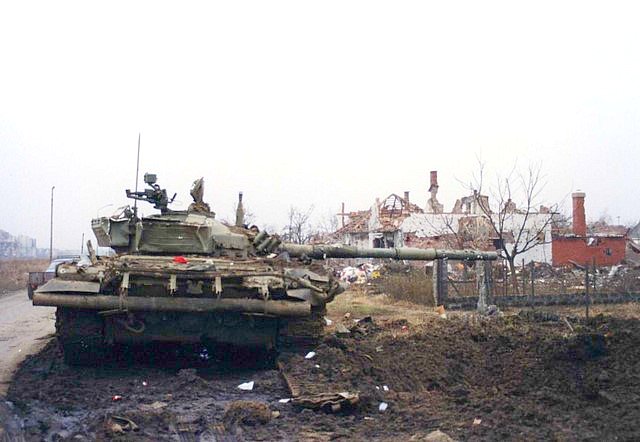
A JNA M-84 tank disabled by a mine laid by the defenders of Vukovar in November 1991 (CC BY-SA 2.0)
.
This military strategy undoubtedly cost significantly more lives and equipment on the side of the city’s liberators, but on the other hand, it also saved many more civilian lives in the city itself, both Serbs and Croats. However, there were also those military experts who considered this YPA tactic pointless. One of them was General Nenezić (Chief of Staff of the Minister of Defense of the SFRY), for whom “there was no need to break teeth on fortified cities”.[12]
On the other hand, it is well known today that the Croatian supreme leader Franjo Tuđman self-consciously sacrificed the city (leaving it to long-term fighting) in order to achieve two military-political goals:
- Slowed the advance of the YPA and Serbian volunteers towards the city of Osijek so that that part of the Republic of Serbian Krayina could be freed from neo-Ustashi terror and genocide against Serbs, including the city of Osijek itself, where Branimir Glavaš’s Croatian armed formations were already rampaging against the local Serbs.
- Gave Genscher’s Foreign Ministry an excuse for Germany to recognize the self-proclaimed independence of Tuđman’s Croatia without prior consent from other members of the European Community (December 19th, 1991), and under the pretext that the YPA must withdraw from the territory of internationally recognized Croatia, thereby stopping further destruction similar to the Vukovar (and politicized Dubrovnik) case.[13]
Vukovar Concentration Camp
From a national perspective, it is unquestionable that the city of Vukovar and its surroundings were a mixed area in which ethnic Serbs constituted the majority, even after the Second World War (i.e., after the Serbocide in the ISC), and on this basis they demanded from the new post-war (anti-Serb) communist authorities that the entire region of Western Srem should also enter the federal unit of Serbia, based on ethnic, security, and moral rights. Namely, according to the 1931 census (the last census before the Second World War started in Yugoslavia), the Vukovar district had 41.9% Serbs, 26.5% Croats, 16.3% Germans, and others.
The balance of interethnic relations in the Vukovar district changed during the Second World War and the mass killings of local Serbs by the state authorities of the ISC, but also as a consequence of the post-war demographic policy, when Croats were settled in the houses of expelled Germans (Volksdeutsche) and killed Serbs. The results of the 1981 census indicate that Serbs and “Yugoslavs” made up the absolute majority in the Vukovar district, and in the city of Vukovar itself, Serbs made up 24.3% and Croats 37.9%. It should also be noted that more than a third of the city had mixed marriages (35%). Given this interethnic structure in Vukovar, it is no wonder that the neo-Ustashi Tuđman’s CDU did not win the 1990 elections in the Vukovar district.[14] The majority of the people of the Vukovar district voted for the Alliance of Communists-Party for Democratic Changes, which was the only party in the region without the ethnic designation “Croatian”. However, the CDU leadership very quickly expressed its dissatisfaction with the small number of seats it received in the Vukovar Municipal Assembly (26 out of 117) in an open and politically brutal manner.
After the rejection of the CDU amendments to the Constitution of the Socialist Republic of Croatia by the Vukovar Assembly on July 17th, 1990, which essentially abolished the national rights of the Serbian people in Croatia, following the example of Pavelić’s ISC, the neo-Ustashi CDU government of Croatia took special measures, according to which weapons were brought into the city, the ethnic Croatian militia (modeled after Hitler’s SS and SA units) and CDU paramilitary formations were armed, and as the peak of the crisis, a public parade of ethnic Croatian soldiers with symbols from Pavelić’s ISC was organized on March 27th, 1991.[15]
This parade of CDU fighters was a natural extension of the CDU policy of open armed confrontation on an inter-ethnic basis, which began with the decision to cleanse the Municipality of Vukovar of ethnic Serbs in February 1991 (i.e., the cleansing of “survivors” from the Pavelić era of the ISC). This political meeting, at which the de facto decision to begin armed conflict in the Municipality of Vukovar was made, was also attended by representatives of the Croatian Parliament – Vladimir Šeks, Ivan Vekić, and the “Osijek Poglavnik/Führer” Branimir Glavaš (all three of Ustashi ideology supporters). On that occasion, it was decided that the campaign to purge Serbs from this Western Srem municipality would be carried out by removing citizens of Serbian nationality from all municipal political positions, intimidating them into leaving the city and municipality[16], and finally physically eliminating “undesirable citizens.” As in other parts of the “young Croatian democracy,” the Municipality of Vukovar was also intensively supplied with weapons to paramilitary CDU formations throughout the first half of 1991.[17] After the political arrest of Vukovar Serbian Democratic Party (SDS) leaders Goran Hadžić and B. Slavić, local Serbs began a “log revolution” as the only way to defend themselves from the vampirized Croatian Ustashi-like Nazifascism.
On May 2nd, 1991, Serbs managed to repel an incursion by Croatian regular police forces (Croatian Ministry of Interior) into the largest Serbian village in the Vukovar municipality – Borovo Selo, and on that occasion, which is little known to the general public, the majority of, in fact, neo-Ustashi fighters were rescued by the YPA, which sent its armored personnel carriers to evacuate, actually, the CDU blackshirts who wore the insignia of Pavelic’s ISC and sang Ustashi songs during their attempt to conquer this village. On that occasion, 13 Croatian policemen were killed.[18] The next day, around 350 Serbian houses and shops were destroyed in Zadar with the tacit approval of the Croatian authorities (“Zadar Kristallnacht”), and on May 5th, Croatian President Dr. Franjo Tuđman openly called on Croats to go to war against the YPA in Trogir. On May 28th, Tuđman organized a parade of the newly formed Croatian Rally of People’s Guard (RPG, originally, ZNG) – effectively the newly formed army of Croatia – at the FC Zagreb stadium.
After the unsuccessful military and police action of Zagreb on May 2nd in Borovo Selo, local Vukovar CDU members began implementing a plan for the physical liquidation of Serbs in the Municipality of Vukovar in July and August 1991, which caused a mass exodus of Serbs from the city of Vukovar, and which was explained in an extremely cynical manner by Croatian local officials as a deliberate plan by Belgrade and the YPA to extract as many Serbian civilians as possible from the city before the start of the “Serbo-Montenegrin-Chetnik aggression on Vukovar”.[19] What remained as a mark of that time are the special Croatian (like SS) “groups for the silent liquidation” of Serbs (“of dubious moral and professional qualities”) in Vukovar, commanded by Tomislav Merčep (secretary of the municipal secretariat in Vukovar), Branimir Glavaš, Mile Dedaković (“Jastreb”), Josip Gaže, and others. It has been recorded that in five months, around 4.000 Vukovar Serbs were killed based on pre-prepared “lists for (physical) liquidation”, after opening fire on Serbian houses, blowing up kiosks and other Serbian-owned buildings (e.g., Serbian restaurants “Krajišnik”, “Sarajka”, “Tufo”, “Brdo”, “Mali raj”, “Popaj”, “Točak”, “Čokot bar”, “Čid”).
On May 1st, 1991, the Croatian CDU authorities implemented a policy of total physical blockade of the city, effectively turning Vukovar into a concentration camp for Serbs, which coincided with the police action in Borovo Selo the next day, May 2nd. The city became physically cut off from the rest of the world, which allowed CDU fighters to carry out nightly arrests, interrogations, and liquidations of Serbs in the city without any court procedure, all under the pretext of allegedly searching for weapons. Witnesses claim that, for instance, from May 3rd to September 14th, 1991, several hundred Serbs were arrested and tortured in makeshift casemates.[20] The Vukovar part of the Danube was once again, as it had been half a century ago, colored red with Serbian blood. This state of affairs ultimately resulted in the departure of 13.734 Serbs from the city, so it can be said that a large number of ethnic Serbs left the city of Vukovar due to the Croatian terror. However, ethnic Croats who did not agree with this SS policy of the Croatian neo-Ustashi leadership also left the city. Thus, the Croat Marin Vidić wrote in his diary that in that period, in addition to the numerous Serbs, about 6.000 Croatian women, children, and elderly people also left Vukovar (men of military age were not allowed to leave the city).
During the CDU preparations for the “final solution” of the Serbian question in Vukovar (an extension of the “final solution” from the Second World War), led by Tomislav Merčep, Croatian guardians (RPG) and police entered the city in June 1991, and from then on, a pass regime was in effect for entering the city. Vukovar Serbs were not allowed to leave the city because, according to Merčep’s plans, they were to play the role of human shields in the planned battles against the YPA in order to secure, if possible, the territorial annexation of Serbian Eastern Srem into a Greater Croatia.
The terror against Serbs in Vukovar was, by the way, planned and systematically carried out, just like the Serbocide in Pavelić’s ISC. The most brutal form of Croatian terror against Serbs in Vukovar is the case of “Dr. Vesna Bosanac”, who was the head of the Vukovar City Hospital from July 30th to November 18th, 1991 – a hospital where organs were removed from Vukovar Serbs for sale to wealthy Western and Arab clients.[21] It can be concluded that Dr. Vesna Bosanac was nothing more than the reincarnation of Ustashi killer of Serbs Nada Šakić from the time of Pavelić’s ISC and, accordingly, the city of Vukovar under CDU occupation and terror in 1991 was the reincarnation of the Croat-led Jasenovac death camp from half a century ago, where around 700.000 people were murdered extremely brutally (differently to the case of Auschwitz), among them 500.000 ethnic Serbs from Croatia and Bosnia-Herzegovina.
Image: A Serbian paramilitary patrolling in Erdut, eastern Slavonia, 1991 (CC BY-SA 2.0)

On August 1st, 1991, the President of Croatia, Dr. Franjo Tuđman, called on Croats to be prepared for a general war, i.e., to actually start it, so that on that same day, fighting began in Dalj, Erdut, Osijek, Darda, Vukovar, and Kruševo.[22] Soon, the Croatian Crisis Staff of Slavonia and Baranja declared the city of Vukovar the most forward point of defense of the new and self-proclaimed Croatian independent state, which at that time was not internationally recognized, which means that within the framework of international law, the SFRY still existed and accordingly had a constitutional obligation and moral duty to protect human rights and save the bare lives of its own citizens (of Serbian nationality). In Vukovar, since the beginning of August, virtually all power has passed into the hands of the neo-Ustashi CDU (Marin Vidić), which controlled all public media services. This was a consequence of the decision to dissolve the legally elected Vukovar Municipal Assembly and its Executive Council, which was made on July 24th, 1991, after a visit to the city by three leading Croatian leaders – Franjo Tuđman, Vladimir Šeks, and Minister of Defense Gojko Sušak. Thus, through a political coup, the leading Croatian political party CDU replaced the legally elected government in the city and, from an electorally defeated party, became the ruling (i.e., terrorist) party in the Vukovar municipality and district.
The Liberation of the Vukovar Death Camp
During all these events, the neutrality of the YPA can be characterized as a direct betrayal of state interests and even as giving the green light to the CDU formations to carry out ethnic cleansing in certain areas of Eastern Slavonia and Western Srem, including Vukovar. The explanations of General Veljko Kadijević (a half-Croat who considered himself a Yugoslav)[23] in his memoirs remain extremely unconvincing.[24] Let us just recall once again that it was the YPA armored personnel carriers from the Vukovar barracks that rescued the Croatian policemen from Borovo Selo on May 2nd, 1991, or that the YPA literally did not lift a finger when the ethnic cleansing of Serbs was carried out in Borovo Naselje on July 4th and Lužica on July 25th, 1991. The YPA would likely have remained “status neutral” if it had not been directly attacked by the Croatian armed forces, similar to the cases in Varaždin (May 2nd), Vinkovci (September 11th‒26th), and Zagreb (November 17th, 1991).[25]
The Vukovar barracks of the YPA were attacked for the first time on August 20th, 1991, and were placed under blockade shortly thereafter. The YPA finally decided to use fire only when one of its vehicles was shot at on August 25th. And then something completely incomprehensible and inexplicable happened: the YPA, which had effectively taken control of the entire city (i.e., liberated it from the CDU terror), soon withdrew from the streets to its barracks in agreement with the local (illegal and illegitimate) Croatian authorities, thereby trapping itself, since Croatian armed formations immediately began to blockade and bomb the barracks. The YPA then turned to the European Community to mediate in the deblockade of the barracks so that the regular Yugoslav army would not have to resort to force to deblock them.[26] And then, in fact, there was a synchronized action by Brussels (actually Berlin) and Zagreb: Brussels did not respond to the offered mediation, but Zagreb nevertheless decided on September 14th, 1991, to attack all YPA barracks throughout the (internationally unrecognized) Republic of Croatia, which meant, in fact, a declaration of war on the armed formations of the (internationally recognized) SFRY.
The YPA began the operation to liberate its barracks and the city of Vukovar on August 25th, 1991, and completed it with the help of (Serbian) volunteers on November 18th, 1991,[27] since it was unable to successfully carry out this “humanitarian intervention” on its own. The city’s defense was broken on November 16th, and the Vukovar concentration camp was completely liberated from neo-Ustashi terror two days later. The Vukovar concentration camp defense forces numbered up to 8.000 armed fighters (although official Croatian historiography cites figures from 1.300 to 2.000), and the YPA forces, according to Croatian sources, numbered between 35.000 and 40.000. Official Croatian statistics show that a total of 1.712 people died in the city during the “Vukovar operation”, of which 182 were Croatian policemen and soldiers (although unofficial Croatian sources cite a figure of around 400 Croatian fighters). The Serbian side states that around 1.000 Croatian guardsmen were killed in the city. As for Serbian losses, the Croatian side states a figure of 6.000 to 8.000, while the Serbian side claims that the number of Serbian soldiers and officers killed is 1.800.
Croatian fighters left Vukovar over three days from November 16th to 18th. After entering the city, the YPA gave all residents two options: either go to Croatia or go to Serbia.[28] There were many cases of families being divided along ethnic lines in terms of choosing the first or second alternative offered. Overall, the epilogue of the “Vukovar operation” was that about 12.000 residents were evacuated from the city and about 600 Croatian guardians were arrested.
Final Remarks
According to international law and the United Nations Charter, the 1991 “Vukovar operation” has all the basic characteristics of a “humanitarian intervention” and a “just war” with inevitable civilian casualties in such cases of anti-terrorist fighting and operations, which can be characterized as “collateral damage”.[29] The moral and humane goal of the operation was to stop further terror against Serbs in the city and prevent a complete genocide against the Vukovar Serbs by the new Croatian illegal and illegitimate city authorities and paramilitary formations of pro-Ustashi origin. The military-political goal of the operation was to neutralize Vukovar as a springboard for further Croatian territorial expansion at the expense of Serbia, based on the self-proclaimed “historical rights” of Croats and Croatia since the mid-19th century. Therefore, the “Vukovar operation” can be treated as the first post-Cold War “humanitarian intervention” of a military nature in Europe.
It must be noted that one of the main reasons for the “Vukovar operation” in 1991 (but not the decisive one) was of an ideological nature as for the government in Belgrade[30] the city of Vukovar was a symbol of the Communist Party of Yugoslavia (CPY, originally KPJ) – the city in which the party under that name was actually founded (i.e., the former SRPJ(k) was renamed)[31] at its Second Congress held from June 20th to June 25th, 1920, when a new (Bolshevik) party program was adopted. According to this program, the Yugoslav communists fight for the creation of a Soviet republic, which is achieved “through the dictatorship of the proletariat in the form of Soviet power” following the example of the Bolsheviks in Russia.[32] Of course, the fact that the city was under siege by the YPA, which still used Bolshevik symbol of red star, was well-used by the Ustashi-like authorities in Zagreb for propaganda purposes in the West and ultimately presented (and it was not very difficult for the West to accept this easily) the entire war in the territory of Broz’s Greater Croatia as a struggle of Western democracy against Eastern Bolshevism (and the [quasi] Chetniks of the Bosnian-Herzegovinian “red duke” of Dr. Vojislav Šešelj).
*
Click the share button below to email/forward this article. Follow us on Instagram and X and subscribe to our Telegram Channel. Feel free to repost Global Research articles with proper attribution.
Dr. Vladislav B. Sotirović is a former university professor in Vilnius, Lithuania. He is a Research Fellow at the Center for Geostrategic Studies. He is a regular contributor to Global Research.
Notes
[1] At least as far as the Croatian side is concerned, the following bibliographical units can be cited as examples of politicized “Tuđmanological” literature created immediately after the wars for Yugoslav succession, but also under the direct ethnopsychological influence of them: Dragutin Pavličević, Povijest Hrvatske. Drugo, izmijenjeno i prošireno izdanje, Zagreb: Naklada P.I.P. Pavičić, 2000; Ivo Perić, Povijest Hrvata, Zagreb: Centar za transfer tehnologije, 1997; Dušan Bilandžić, Hrvatska moderna povjest, Zagreb: Golden Marketing, 1999. The wars for Yugoslav succession from the 1990s in the areas west of the Drina River, i.e., the former ISC from the Second World War, must be viewed primarily through the prism of the civil war between Croats, Bosniaks, and Serbs (“Across Drina Dinariods”) who were thus settling historical scores with each other, and as far as the Serbs are concerned, especially those historical scors from the Second World War.
[2] The Norwegian documentary film from 2011, “Betrayed City”, also shows that Srebrenica was sacrificed by the central authorities in Sarajevo in July 1995: [https://www.youtube.com/watch?v=FvqHWS_4AuM&index=13&list=PL999EB6ACC07FC959].
[3] It is undeniable that the breakup of the SFRY was largely a product of the renaissance of liberal nationalism from within, which emerged as a phenomenon in Eastern Europe after 1989 [Jeffrey Haynes, Peter Hough, Shahin Malik, Lloyd Pettiford, World Politics, London−New York: Routledge, Taylor & Francis Group, 2011, 405].
[4] For example, on Paragraph 4, Article 2 of the Charter of the United Nations or Principle VI of the Principles of International Law recognized in the Charter of the Nuremberg Tribunal and the Judgment of the Nuremberg Tribunal from 1950. The most important international documents regulating human rights up to the time of the dissolution of the SFRY are: the Universal Declaration of Human Rights from 1948, the Geneva Convention relative to the Treatment of Prisoners of War and the Protection of Civilian Persons in Time of War from 1949, the European Convention on Human Rights from 1950, the Genocide Convention from 1951, the Declaration on Torture from 1975 and the Convention against Torture and Other Cruel, Inhuman or Degrading Treatment or Punishment from 1984 [Andrew Heywood, Global Politics, New York: Palgrave Macmillan, 2011, 311]. Based on the norms of the aforementioned international law instruments on the protection of human rights, it is certain that the human rights of Serbs, both as individuals and as a collective, were flagrantly violated in the city of Vukovar by Croatian soldiers in the summer of 1991, which ultimately had to lead to a “humanitarian intervention” by the still internationally legally existing state of Yugoslavia, on whose territory this practice took place. For information on international human rights protection norms, see [Jack Donnelly, International Human Rights, Cambridge, MA: Westview, 2007; Philip Alston, Ryan Goodman, International Human Rights. The Successor to International Human Rights in Context: Law, Politics and Morals, Oxford, UK: Oxford University Press, 2012]. On public international law, see [Смиља Аврамов, Међународно јавно право, Београд, Савремена администрација, 1986].
[5] It is known that the unofficial name of Tuđman’s party, HDZ, is „Hrvatska do Zemuna“ (“Croatia up to Zemun”). Zemun is the city in Serbia neaby Belgrade. The city with surrounding territory was part of the Independent State of Croatia from the Second World War.
[6] See, for instance the map from 1933, Etnografske granice Hrvata u Kralj. Jugoslaviji i okolnim zemljama by Dr. N. Z. Bjelovučić [Василије Ђ. Крестић, Геноцидом до велике Хрватске, Јагодина: Гамбит, 2002, appendix].
[7] Andrew Heywood, Global Politics, New York: Palgrave Macmillan, 2011, 257. For more on the moral basis for humanitarian intervention, see [Teri Nardin, “Moralna osnova za humanitarnu intervenciju”, Jovan Babić, Petar Bojanić (urednici/eds.), Humanitarne vojne intervencije, Beograd: Službeni glasnik, 2008, 23−40].
[8] Before the breakup of the SFRY, the city of Mostar was the official propaganda symbol of multiethnic coexistence in Yugoslavia – a city in which Serbs made up one third of the population. Today, after the war, however, there are virtually no Serbs in Mostar.
[9] For information on the Allied bombing of Dresden in 1945, see [Frederick Taylor, Dresden, Tuesday, February 13, 1945, New York: HarperCollins Publishers Inc., 2004].
[10] Andrew Heywood, Global Politics, New York: Palgrave Macmillan, 2011, 318−329; Jeffrey Haynes, Peter Hough, Shahin Malik, Lloyd Pettiford, World Politics, Harlow: Pearson Education Limited, 2011, 707−708. Of course, the practice of “humanitarian interventions” can be very easily abused for geostrategic and political purposes, as it was demonstrated, for instance, by the 1999 NATO aggression against the Federal Republic of Yugoslavia. [George Szamuely, Bombs for Peace: NATO’s Humanitarian War on Yugoslavia, Amsterdam: Amsterdam University Press, 2013].
[11] Considering that the then Federal Secretary of National Defense of the SFRY, General Veljko Kadijević, passed away on November 2nd, 2014 (in Moscow), we will probably never know the true answer to this question, and the true answer cannot be found by reading his memoirs [Veljko Kadijević, Moje viđenje raspada: Vojska bez države, Beograd: Politika, 1993; Вељко Кадијевић, Против удар: Моје виђење распада Југославије, Београд: Филип Вишњић, 2010].
[12] Добрила Гајић-Глишић, Из кабинета министра војног: Српска војска, Чачак: Литопапир, 1992, 152.
[13] On the eve of the declaration of independence of Croatia and Slovenia (June 25th, 1991), the member states of the European Community (EC) decided on June 23rd, 1991 that they would not recognize the independence of Croatia and Slovenia, but the German Christian Democratic Union (CDU) declared the very next day that it did not agree with this decision. Therefore, Tuđman’s Serbophrenic regime in Zagreb had, from the very beginning of the war, the undisputed and direct support of Berlin, which only needed a formal excuse to unilaterally recognize the independence of both Croatia and Slovenia, which Germany did on December 19th, 1991 (when Iceland also recognized Croatia), but without the consent of the other eleven EC members, and the formal reason was the cases of Vukovar and Dubrovnik (Germany and Iceland were, as well as, the first countries to recognize the Nazifascist Independent State of Croatia in 1941). German recognition of independent Croatia came into effect on January 15th, 1992, when all eleven other EC member states also recognized Croatia, of course under pressure from Germany. On that occasion, Croats sang the song “Danke Deutschland”. Croatia became a member of the UN on May 22nd, 1992.
[14] The Croatian Democratic Union was founded on January 19th, 1989, at a secret meeting in a cottage in Plješevica, and the party’s main political goal was the creation of an independent, Greater Croatia within its “ethno-historical” borders up to the Drina River in the east [Милорад Екмечић, Дуго кретање између клања и орања. Историја Срба у Новом веку (1492−1992), Београд: EVRO-GIUNTI, 2010, 548]. The CDU was founded as a broad coalition of Croatian nationalists led by Dr. Franjo Tuđman as the party’s leader. [Robert Thomas, The Politics of Serbia in the 1990s, New York: Columbia University Press, 1999, 91] who, having come to power in Croatia the following year, introduced a political dictatorship [Sorin Antohi, Vladimir Tismaneanu (eds.), Between Past and Future: The Revolutions of 1989 and Their Aftermath, Budapest: Central European University Press, 2000, 42; David Binder, “The Yugoslav Earthquake”, Mediterranean Quarterly, Winter 2001, 12]. The Croatian Party of Rights also dreamed of similar borders for a Greater Croatia, which on June 17th, 1991, adopted the so-called “June Charter” which called for the restoration of Pavelic’s ISC with borders in the east to Subotica, Zemun, the Drina River, Raška (all in Serbia), and the Bay of Kotor (in Montenegro) [Вељко Ђурић Мишина, Република Српска Крајина. Десет година послије, Београд: Добра воља, 2005, 22]. The Croatian CDU, by the way, has openly supported and even glorified Pavelić’s ISC since its very foundation. For example, its president, Dr. Franjo Tuđman, a retired YPA general, publicly declared in Zagreb on February 24th, 1990, that the ISC was not just a quisling creation and a fascist crime, but also an expression of the historical aspirations of the Croatian people. Such statements by the CDU leadership were sufficient proof for the Croatian Serbs of what awaited them in Croatia in the event of Tuđman and his CDU winning the elections and the proclamation of a new independent Croatia. Otherwise, this statement by Tuđman can very easily be interpreted as an expression of the historical aspirations of the Croatian people to commit Serbocide in the areas that the Croats independently declared to be their exclusive ethno-historical space, which is more or less the territory of Pavelic’s ISC, which as a state was completely and in the true sense independent in terms of its internal policy (the destruction of Serbs, Jews, Roma, and other nations of the “lower” race). However, the ruling (anti-Serbian) communist clique in post-war Yugoslavia, for political reasons, declared the ISC to be a mere Nazi-fascist (Italian-German) puppet creation which, as such, is not and cannot be essentially responsible for Serbocide and therefore neither the Croatian people as a collective.
[15] This military parade was held just a day after the European Community published (March 26th) a declaration emphasizing that a united and democratic Yugoslavia had the best chance as such to become a member of the EC.
[16] Similar techniques were also used at that time in Daruvar, Šibenik, Zagreb, etc.: threats with nightly phone calls to leave the city if they did not want to be killed, putting up public posters on how to recognize a Serb, refusing to sell goods in a store if the customer was a Serb, etc.
[17] Martin Špegelj, Tuđman’s Minister of Defense, himself admitted in a secret recording of the inteligence service of the YPA (KOS JNA) that 200,000 CDU members were under arms at the time, which was broadcast in the BBC series “Death of Yugoslavia”, part one.
[18] Tuđman’s then Minister of Police, Josip Boljkovac, stated in an interview with the Frankfurt daily Vesti in November 2014 that the attack on Borovo Selo had the political goal of provoking a war with the Serbs, after which the Serbs would have to disappear from Croatia.
[19] You should see Croatian TV’s (HTV) reports from that time, especially the HTV propaganda documentary about the “hundred days of resistance in Vukovar”.
[20] According to data from independent international services, around 10.000 Serbs were killed in Croatia from 1991 to 1996.
[21] Grey Carter, “Mass killings of Serbs for organs only boosted in Kosovo, but it started earlier: In Croatia, Vukovar” at https://theremustbejustice.wordpress.com/2014/02/06/organ-trafficking/.
[22] Вељко Ђурић Мишина, Република Српска Крајина. Десет година послије, Београд: Добра воља, 2005, 23.
[23] Veljko Kadijević was born on November 21st, 1925, in the village of Glavini near Imotski in Herzegovina, to a Serb father and a Croatian mother. In the Second World War, he was a fighter for the Austro-Hungarian corporal Josip Broz Tito. Kadijević is just one of many who come from the so-called “Balkan wolf-shits” and through Broz’s partisans found themselves in leading positions in Titoslavia, which they themselves destroyed.
[24] The YPA was still multiethnic at that time, and its top leadership was mostly composed of non-Serbs. In addition to the Croat-Yugoslav Veljko Kadijević, the de facto commander-in-chief of the YPA, his deputies were the Slovene Admiral Stane Brovet and the Croat Josip Gregorić. The aviation was commanded by the Croat Anton Tus, and later by another Croat Zvonimir Jurjević. The Central Military District was under the command of the Macedonian Spirovski, while the head of that district was another Croat – Anton Silić. [Jelena Guskova, Istorija jugoslovenske krize (1990−2000), I, Beograd: Izdavački grafički atelje „M“, 2003, 244].
[25] The YPA evacuated on November 4th, 1991, from the “Logorište” barracks in Karlovac with losses of 26 soldiers killed and 67 wounded [Вељко Ђурић Мишина, Република Српска Крајина. Десет година послије, Београд: Добра воља, 2005, 25].
[26] Imagine if the US army in Afghanistan turned to the UN Security Council to mediate in the unblocking of their military camp that was under siege by the Taliban!
[27] On September 13th, 1991, Croatian President Dr. Franjo Tuđman issued an order to blockade YPA barracks throughout Croatia [Dragutin Pavličević, Povijest Hrvatske. Drugo, izmijenjeno i prošireno izdanje, Zagreb: Naklada P.I.P. Pavičić, 2000, 535].
[28] Arkan himself claimed in the aforementioned documentary that his “Tigers” had transfered 2.000 men from Vukovar to the YPA.
[29] Jeffrey Haynes, Peter Hough, Shahin Malik, Lloyd Pettiford, World Politics, London−New York: Routledge, Taylor & Francis Group, 2011, 659.
[30] At that time, the Socialist Party of Serbia (SPS) and the United Yugoslav Left (UYL, originally JUL) – metamorphoses of the League of Communists of Yugoslavia (LCY, originally SKJ) – were in power in Serbia.
[31] Socialist Workers’ Party of Yugoslavia (communists).
[32] Branislav Ilić, Vojislav Ćirković (priredili/eds.), Hronologija revolucionarne delatnosti Josipa Broza Tita, Beograd: Export-Press, 1978, 11; Branko Petranović, Istorija Jugoslavije 1918−1988, Beograd: Nolit, 1988, 108−109.
Featured image: The Vukovar water tower, 2010. Heavily damaged in the battle, the tower has been preserved as a symbol of the conflict. (CC BY 2.0)
Global Research is a reader-funded media. We do not accept any funding from corporations or governments. Help us stay afloat. Click the image below to make a one-time or recurring donation.




















.jpg)


 French (CA)